Views: 0 Author: Kathy Yee Publish Time: 2026-08-07 Origin: https://taihusnow.com/


Sampling is the single highest-leverage stage of a silk order. It costs a small fraction of your bulk budget, yet it decides whether the 2,000 pieces that follow arrive correct or arrive wrong. Most sourcing problems that surface at delivery — the wrong white, a logo that sits 8 mm off, a hand-feel that does not match the pitch deck — were decisions that were never properly locked at the sample stage.
This guide explains how silk sampling actually works from the factory side: which type of sample to ask for and when, what each one costs and proves, realistic timelines, how to write a sampling brief that avoids revision rounds, and how to approve a sample so it legally and practically governs your bulk production.
We are Taihu Snow Silk, a vertically integrated mulberry silk manufacturer in Suzhou, China, established in 2002 and publicly listed (Stock Code 920262). We run our own mulberry farms, weaving, dyeing and assembly, so the notes below reflect how sampling is genuinely sequenced and costed in a silk factory.
There are four useful sample types: stock samples (prove silk quality), fabric or lab dips (prove color), logo or branding samples (prove your mark), and pre-production samples (prove the finished product). At Taihu Snow, standard samples are ready within 5–7 business days and custom printed or embroidered samples within 7–10 days. Sample fees are typically refunded against your subsequent bulk order. Approve the final sample as a sealed sample, and bulk production of 15–30 days is then inspected against it.
Buyers naturally spend their energy negotiating unit price. But in silk, the variables that destroy margin are rarely the quoted price — they are rework, delayed launches, and unsellable stock.
A sample stage does three things a quotation cannot:
● It converts adjectives into specifications. "Premium, soft, ivory" becomes 22 momme, 6A mulberry charmeuse, Pantone 11-0602 TCX.
● It exposes the gap between your artwork and manufacturing reality. Embroidery thickness, print bleed on silk, and hem behavior only reveal themselves physically.
● It creates an objective reference for the QC stage. Without an approved physical standard, "wrong shade" is an argument. With one, it is a measurable defect.
Treat sampling as buying certainty, not as buying a sample.
Different samples answer different questions. Ordering the wrong one wastes a week; ordering them in the wrong order wastes two.
Sample type | What it proves | Typical lead time | When to use |
Stock sample | Silk quality, momme, hand-feel, construction | 3–5 days (ships from existing stock) | First contact with a new supplier, before any custom work |
Fabric swatch / lab dip | Color accuracy against Pantone, dye consistency | 5–7 days | Any custom colorway, especially brand-critical shades |
Logo / branding sample | Embroidery density, print fidelity, label placement | 7–10 days | Private label, when the mark is the main risk |
Pre-production sample (PPS) | The complete finished product exactly as bulk will be made | 7–10 days after specs are locked | Always, before releasing bulk production |
Order this first and order it cheaply. A stock sample tells you whether the factory's baseline silk is what you want to build a brand on — the weight, the sheen, the stitching, the finishing. If the stock sample disappoints, no amount of customization will rescue the project, and you have spent very little to learn that.
Color is the most common cause of sample rejection in silk. Silk takes dye differently from cotton, and screens render color differently from woven fiber. Send a physical Pantone TCX reference where possible rather than a digital value. Approve dye lots on physical swatches under consistent lighting.
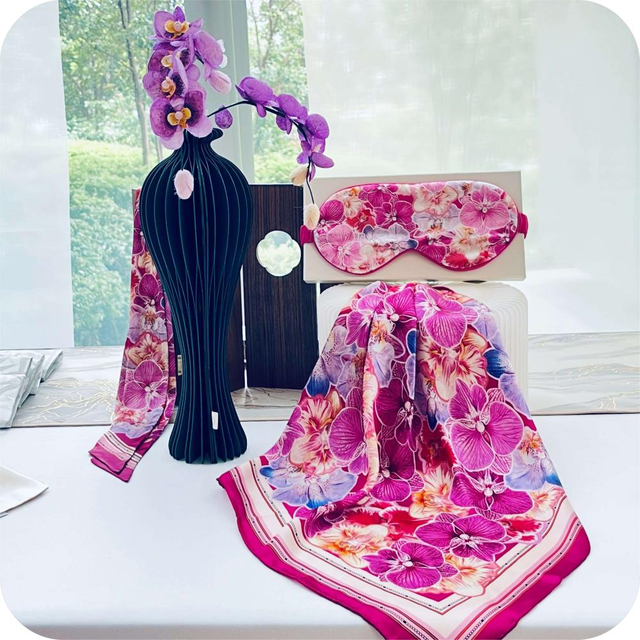
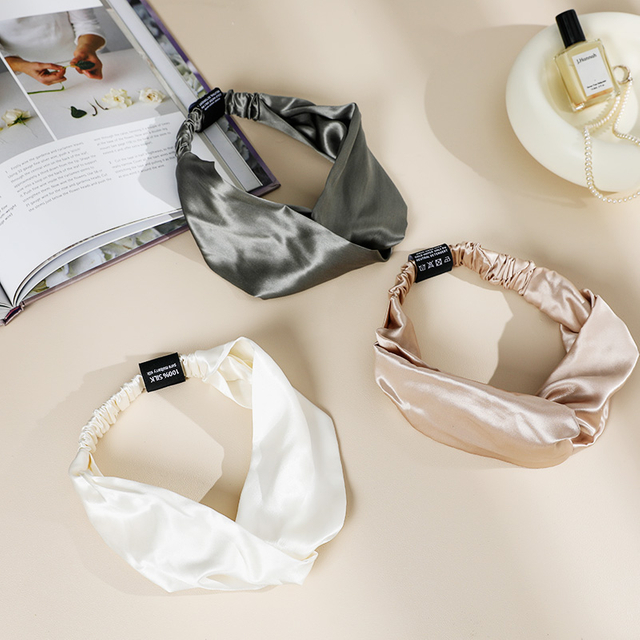
If your brand mark is doing the work — as with custom silk scrunchies carrying woven tags, or printed silk scarves carrying an all-over design — test the branding independently before committing it to a full product sample. This isolates the variable and shortens revision cycles.
The PPS is the sample that matters commercially. It is made with bulk materials, bulk methods and bulk packaging. Nothing about it should be hand-finessed for presentation. Once approved, it becomes the sealed sample and the reference standard for inspection.
Never skip the PPS to save a week. A week saved here routinely costs three weeks later.
Sample pricing follows a simple logic: you are paying for machine setup and skilled labor on a batch of one, not for a unit of silk.
● Sample fee covers fabric, pattern making, labor, and any setup for printing or embroidery.
● Custom branding raises the fee because screens, embroidery files, or print files must be created for a single piece.
● Freight is normally paid by the buyer, via DHL or FedEx.
● Refund policy: at Taihu Snow, the sample fee is refunded against your subsequent order. Confirm this in writing with any supplier, including the conditions and the order size that triggers the refund.
Two practical cautions. First, a supplier offering completely free custom samples with no commitment is often either absorbing the cost into your unit price or is a trading company passing your file to a third party. Second, ask explicitly whether the sample is made on the same line as bulk. A hand-made showpiece from a sample room is not evidence of what a 3,000-piece run will look like.
Published lead times at Taihu Snow:
● Standard samples: 5–7 business days
● Custom printed or embroidered samples: 7–10 days
● Order confirmation after sample approval: 1–2 days
● Bulk production: 15–30 days depending on quantity and color availability
● Shipping: express 3–5 working days to most countries, air freight 7–10 days, sea freight roughly 30–45 days
Now add the variable nobody schedules: revision rounds. Each round of sample revision adds another 7–10 days. One revision is normal. Three revisions usually indicates the original brief was underspecified.
If you need stock on shelf on 1 October, and you are shipping by sea:
Stage | Duration | Latest start |
Sea freight + customs + local delivery | ~45 days | 15 August |
Bulk production | 15–30 days | 15 July |
Order confirmation | 1–2 days | 13 July |
Sampling, allowing one revision | ~20 days | 23 June |
Brief, quotation, artwork | ~10 days | 13 June |
In other words, a 1 October launch means starting in mid-June. Add buffer around Chinese New Year and the Golden Week holiday, when the entire supply chain compresses.
Most revision rounds are caused by briefs that leave a decision to the factory that the buyer had already made privately. Specify all of the following:
● Product and construction: item, closure type, seam finish, lining
● Silk specification: momme (19, 22 or 25), grade (6A), weave (charmeuse, twill)
● Dimensions: finished measurements with tolerance, not just "queen size"
● Color: Pantone TCX reference, physical swatch where possible, and which market's lighting standard applies
● Branding: logo method (woven label, embroidery, digital print), exact placement measured from a defined edge, thread or ink color, and vector artwork
● Packaging: whether the sample should include the intended dust bag, box, insert and hang tag
● Labeling and compliance: care label wording, fiber content, country of origin, and any market-specific requirements
● Quantity and timeline: intended bulk quantity per color, and the target delivery date
Send artwork as vector files (AI, EPS, or PDF) with fonts outlined. Raster logos scaled up are a leading cause of embroidery disappointment.
If you are protecting an original design, ask for a confidentiality agreement before you send files. We sign an NDA with brand clients as standard and delete files on request at project close.
Inspect deliberately, and document. Photograph the sample under consistent light next to your Pantone reference and keep the images with your file.
Work through this checklist:
● Silk authenticity and weight. Does the hand-feel match the stated momme? Real mulberry silk is cool to the touch, warms quickly, and has a soft irregular sheen rather than a uniform mirror gloss.
● Color under multiple light sources. Check daylight, retail LED, and warm indoor light. Metamerism — matching under one light and failing under another — is common with silk.
● Dimensions against your spec sheet. Measure; do not eyeball. Confirm the tolerance is agreed in writing.
● Seams and stitch density. Look for puckering, skipped stitches, and loose thread ends.
● Logo execution. Check placement measured from the edge, embroidery density, and whether the reverse side of embroidery is acceptable against skin.
● Print quality. Check registration, saturation, edge crispness, and whether print penetrates the fiber or sits on the surface.
● Hem and edge finish. On scarves, confirm hand-rolled versus machine-rolled matches what was quoted.
● Hardware and elastic. Test recovery on elastic; check that any hardware is not silk-snagging.
● Wash test. Wash one sample per your intended care label and re-measure for shrinkage and colorfastness. This step is skipped constantly and is the origin of most post-launch complaints.
● Packaging fit. Confirm the product actually fits its intended box or pouch without compression creasing.
Give consolidated feedback in a single document with numbered points and annotated photos. Fragmented feedback across several messages is the fastest route to a third revision round.
Approval is not an email saying "looks good." Approval means creating a controlled reference:
1. Both parties sign and date a physical tag attached to the approved sample. This is the sealed sample or golden sample.
2. The factory retains one; you retain one. Where a third-party inspector is engaged, a third is held for them.
3. The written specification sheet is attached to the sales contract, so the sample and the contract describe the same product.
4. Bulk is then inspected against the sealed sample, not against memory.
At Taihu Snow, in-house QA and QC operate at pre-production, in-line and off-line stages, and we welcome third-party inspection by SGS, Bureau Veritas, Intertek or any inspector you appoint. All products are OEKO-TEX Standard 100 compliant and the factory is ISO 9001 certified; you can review our OEKO-TEX certification directly.
For any buyer placing a first order, booking a pre-shipment inspection against the sealed sample is inexpensive insurance and signals that you intend to hold the standard.
Our published order flow places sampling as step four of nine:
1. Inquiry — response within 24 hours
2. Customized solutions
3. Price quotation
4. Sample proofing
5. Sales contract with advance payment
6. Production
7. Full payment
8. QC
9. Delivery
Standard payment terms are 30% deposit and 70% before shipment, with T/T, L/C, PayPal and Western Union accepted. MOQ is 100 pieces per color for custom production, while standard designs can start from 10–20 pieces for market testing — which makes a genuine trial order feasible before scaling. Full details are on our FAQ page and OEM hub.
● Approving from photographs. Screens misrepresent silk sheen and color entirely.
● Skipping the wash test because the sample looks perfect dry.
● Sampling one color and assuming the others will behave identically. Deep saturated shades and whites carry the most dye risk.
● Leaving logo placement as "centered." Specify millimeters from a defined edge.
● Sampling the product but not the packaging, then discovering at bulk that the box is 5 mm too small.
● Treating the sample fee as the decision criterion. The cost of one wasted production run exceeds every sample you will ever order.
Standard samples are ready within 5–7 business days; custom printed or embroidered samples take 7–10 days. Allow an additional 7–10 days for each revision round.
At Taihu Snow the sample fee is refunded against your subsequent order. Always confirm refund conditions in writing before paying.
Stock samples for quality assessment can often be arranged with the buyer covering freight. Fully custom samples carry a fee because they require dedicated setup, artwork processing and labor.
At minimum, a stock sample to validate the supplier and a pre-production sample to validate the finished product. Add a lab dip for brand-critical colors and a logo sample where branding is complex.
A sample approved and signed by both buyer and factory, retained by each party, and used as the physical reference standard for inspecting bulk production.
Yes. We sign a confidentiality agreement before receiving your designs, store files on encrypted servers, and delete them on request when the project closes.
Yes. We welcome SGS, Bureau Veritas, Intertek or any third-party inspector you choose, in addition to our own in-house QC.
Tell us the product, silk specification, branding method, packaging and target quantity, and our team will respond within 24 hours with a quotation and a sampling plan. Standard samples ship within 5–7 business days.
Request a sampling quote — or explore what can be customized on our OEM and private label hub.
Related reading:
● Silk Scrunchies Wholesale: Custom, XXL & Bulk
● Custom Silk Scarves Wholesale: Printing, Sizes & MOQ Explained
● Custom Silk Packaging: Dust Bags, Pouches & Gift Boxes
The Ultimate Guide to Sourcing Silk Products in China